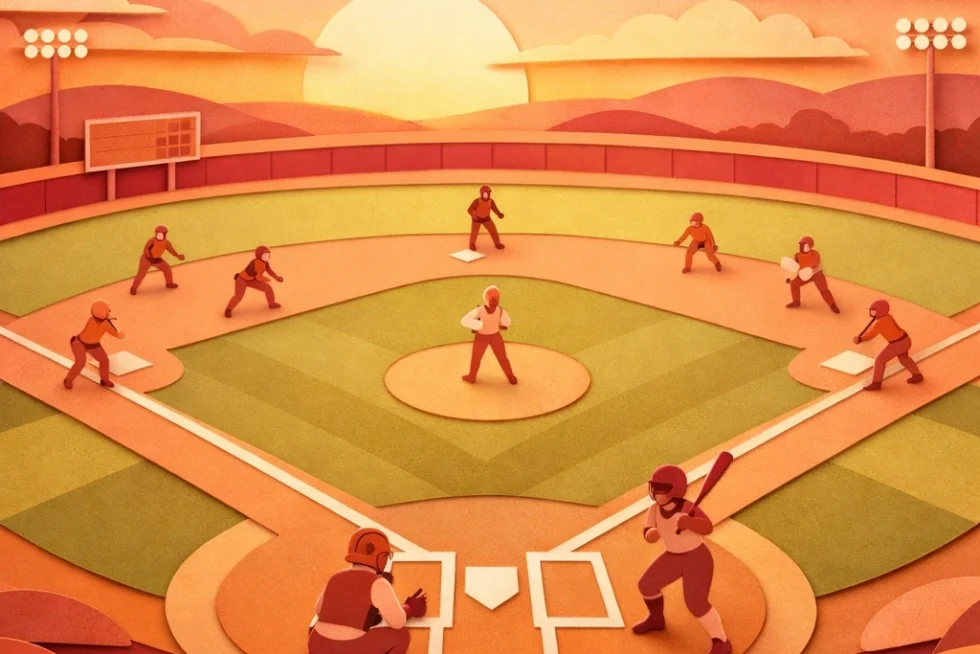
Softball is a bat-and-ball sport in which two teams alternate between batting and fielding on a diamond-shaped field. The batting side tries to put the ball in play, move runners around the bases and bring them safely to home plate. The fielding side tries to stop that progress by recording outs.
The easiest way to follow a game is to focus on that change of roles. One team is attacking at the plate and on the bases; the other is defending the field. When the defence records outs, it works towards ending the batting team’s opportunity and taking its own turn to bat.
What is softball?
Softball shares the basic logic of many bat-and-ball games: a pitcher delivers the ball, a batter attempts to hit it, runners advance around a diamond, and the defence tries to get them out. It is a team game, but each play often begins with a direct contest between pitcher and batter.
The two primary forms are fast-pitch and slow-pitch. Both use underhand pitching, which is one of the clearest visual features of the sport. That does not mean every delivery looks alike. Fast-pitch has its own characteristic pitching action, while slow-pitch is a separate main form of the game.
For a new viewer, the most useful starting point is not to worry about every possible rule at once. Watch where the ball goes after the pitch. If it is hit into play, attention moves quickly from the batter to the runners and the fielders trying to make an out. If the batter receives three strikes, the at-bat ends in a strikeout.
That flow gives softball its rhythm: pitch, swing or take, ball in play where applicable, then a race between offensive progress and defensive execution.
How a softball game begins and teams take the field
Before play begins, each coach sets a line-up. That line-up establishes the batting order and assigns fielding positions to players. The batting order matters because it determines the sequence in which players come to the plate, while the fielding assignments establish who is defending when the other team bats.
Teams then take turns in their two roles. One side bats while the other fields, and those roles reverse as the game progresses. Changes to a player’s position or the batting order are not simply informal switches: the coach must notify the umpire before making them.
This is the central organisational idea behind softball. A team does not bat and field at the same time. Its objective changes with its turn: score runs when batting, and prevent runs while making outs when fielding.
The playing area and route around the bases
Softball is played on a diamond-shaped field. The diamond is more than a backdrop: it sets the route an offensive player follows after putting a ball in play. A batter who becomes a runner advances counterclockwise, moving from first base to second base, then third base, and finally home plate.
That route explains why plays can become so fast-moving. The batter-runner is trying to progress around the diamond, while fielders are trying to control the ball and make a play before that progress is completed. A runner is not trying to move randomly around the field; the bases give the action a fixed direction.
The precise measurements and marking specifications for a softball field can vary by ruleset and competition, so players should use the requirements supplied by the league or association they are joining. The key viewing point is simpler: first, second, third and home form the counterclockwise scoring path.
Once that pattern is clear, a play becomes easier to read. A hit may create an opportunity for the batter-runner to reach a base, while runners already on the diamond may be trying to continue their own route towards home.
How an at-bat works
An at-bat begins with the pitcher delivering the ball underhand to the batter. The batter’s task is to deal with that delivery and, when the ball is put in play, begin the journey around the bases. The pitcher’s task is to make that difficult and help the fielding team record an out.
In fast-pitch softball, pitchers typically use a windmill motion and release the ball at hip level. It is a distinctive action: the arm circles through before the underhand release. For someone watching fast-pitch for the first time, that motion is an immediate clue that the pitcher is working within a fast-pitch style of delivery.
The batter and pitcher are at the centre of the action, but the result can involve the entire defence. A batted ball may be caught, fielded for a force play, or create a situation in which a runner can be tagged. Even when the batter does not put the ball in play, three strikes produce an out.

There is no need to treat every pitch as an isolated event. Each one either keeps the at-bat alive, ends it with a strikeout, or sends play into the field. That is the practical sequence to watch.
How runs are scored
The offensive team scores when a player safely touches home plate. The basic route is fixed, even though a single play can involve more than one runner moving at once.
- Put the ball in play. After hitting the ball, the batter becomes a batter-runner and heads towards first base.
- Advance around the diamond. The route continues counterclockwise from first to second, then third. Each step brings the runner closer to scoring.
- Reach home safely. A run counts when the offensive player safely touches home plate.
- Complete the route on one hit. If a hit allows the batter to reach home plate, it is a home run.
In practice, scoring is a contest of timing. The offence wants runners to keep moving safely around the bases; the defence wants to stop that movement with an out. A home run is easy to recognise because the batter completes the whole route to home, but the same scoring destination applies whenever any offensive player reaches home safely.
How the fielding team gets outs
The defence records outs in several core ways. Learning these outcomes is one of the quickest ways to understand what is at stake on a given play.
A strikeout occurs when a batter accumulates three strikes. This is the outcome created directly through the pitcher-batter contest: the batter is out without needing the ball to be fielded after a hit.
A flyout happens when a fielder catches a batted ball before it touches the ground. When the ball rises into the air, viewers often shift their attention to the fielder moving underneath it. If the catch is made cleanly before the ball lands, the batter is out.
A tag out occurs when a fielder, holding the ball, tags a runner who is off a base. Here, the runner’s location matters. A runner can be caught between bases or otherwise away from one, and the defence can make the out by applying the tag with possession of the ball.
A force out is different. It occurs when a fielder has the ball and touches the base a runner is forced to reach before the runner arrives. This is why throws to a base can matter as much as a direct tag: the defender is racing the runner to the required destination.
These four outcomes provide a solid viewing framework. Three strikes end the batter’s turn; a caught ball produces a flyout; a tag can retire an off-base runner; and a ball delivered to the necessary base can produce a force out.
Essential softball equipment
The central piece of playing equipment is the softball itself. Hitters use a bat, which may be made from composite material or metal. Once the ball is put in play, fielders use gloves to catch or handle it as they try to make defensive plays.
For the batting side, a batting helmet is part of the basic protective equipment. Batters wear them at the plate, and runners wear them while advancing around the bases. That makes the helmet a visible link between the two offensive stages of play: the player who starts as a hitter may quickly become a runner.
A simple way to sort the equipment is by purpose. The ball and bat create the batting contest. Gloves help the defence field the ball. Helmets protect batters and runners during offensive play.
Clubs and competitions may have their own equipment requirements, particularly for protective gear, so a prospective player should check the rules that apply to their team before buying anything beyond these basics.
Fast-pitch, slow-pitch and other formats
Fast-pitch and slow-pitch are softball’s two primary forms. Their shared feature is underhand pitching: in both, the pitcher delivers the ball underhand to the batter. That common foundation means the broad sequence of batting, fielding, running and scoring remains familiar across the two forms.
The most clearly identifiable fast-pitch characteristic is the pitching motion. Fast-pitch pitchers typically use a windmill action, releasing the ball at hip level. This gives fast-pitch its recognisable look and helps explain why the pitcher’s delivery is such a focal point in that version of the sport.
It is best not to assume that every rule carries across unchanged between formats. Details can be set by the competition being played. Modified softball is also used as a format label in some contexts, but its complete rules and its differences from fast-pitch and slow-pitch should be checked with the relevant local competition rather than guessed from the name.
For a beginner, the practical distinction is straightforward: recognise fast-pitch and slow-pitch as the main forms, notice their shared underhand delivery, and look for the windmill motion as a typical fast-pitch feature.
Finding a place to play in Australia
Joining a club or association is a practical way to move from watching softball to playing it. These local organisations are where prospective players can ask about opportunities, teams and the arrangements that apply in their area.
In Victoria, Softball Victoria identifies itself as the state sporting organisation for softball and directs participants towards playing through a club and association. That makes local club and association connections a sensible starting point for someone looking to get involved there.
In South Australia, Softball SA offers a club finder for people searching for a club. A club finder can be particularly useful for a newcomer because it turns a broad interest in playing into a local search.
Elsewhere, the most useful next step is to look for the relevant state or local softball body and ask about nearby clubs and associations. Local competitions can set the practical details that matter to a new player, including registration arrangements, playing opportunities and applicable rules.